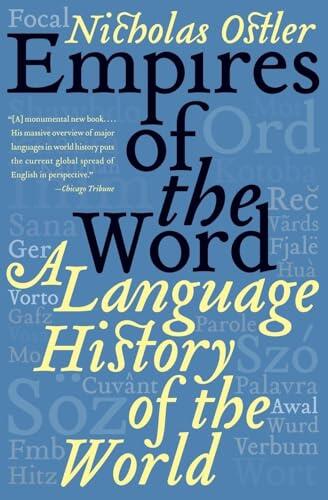
Nicholas Ostler's Empires of the Word is the first history of the world's great tongues, gloriously celebrating the wonder of words that binds communities together and makes possible both the living of a common history and the telling of it. From the uncanny resilience of Chinese through twenty centuries of invasions to the engaging self-regard of Greek and to the struggles that gave birth to the languages of modern Europe, these epic achievements and more are brilliantly explored, as are the fascinating failures of once "universal" languages. A splendid, authoritative, and remarkable work, it demonstrates how the language history of the world eloquently reveals the real character of our planet's diverse peoples and prepares us for a linguistic future full of surprises.
Descripción del producto
Críticas
“[A] wide-ranging history of the world’s languages... [Ostler] brilliantly raises questions and supplies answers or theories.” — Washington Post
“Enlightening . . . Always challenging, always instructive--at times, even startling or revolutionary.” — Kirkus Reviews
“Delicious! Ostler’s book shows how certain lucky languages joined humankind in its spread across the world.” — John McWhorter
“What an extraordinary odyssey the author of this superb work embarked upon.” — Literary Review
“Covers more rambunctious territory than any other single volume I’m aware of...A wonderful ear for the project’s poetry.” — John Leonard, Harper's Magazine
“Revolutionary... Executed with a giddying depth of scholarship, yet the detail is never too thick to swamp the general reader.” — Boston magazine
“True scholarship. A marvelous book, learned and instructive.” — National Review
“[A] monumental new book... Ostler furnishes many fresh insights, useful historical anecdotes and charming linguistic oddities.” — Chicago Tribune
“A work of immense erudition.” — Christian Science Monitor
“A story of dramatic reversals and puzzling paradoxes. A rich... text with many piercing observations and startling comparisons.” — Los Angeles Times Book Review
Contraportada
Nicholas Ostler's Empires of the Word is the first history of the world's great tongues, gloriously celebrating the wonder of words that binds communities together and makes possible both the living of a common history and the telling of it. From the uncanny resilience of Chinese through twenty centuries of invasions to the engaging self-regard of Greek and to the struggles that gave birth to the languages of modern Europe, these epic achievements and more are brilliantly explored, as are the fascinating failures of once "universal" languages. A splendid, authoritative, and remarkable work, it demonstrates how the language history of the world eloquently reveals the real character of our planet's diverse peoples and prepares us for a linguistic future full of surprises.
Biografía del autor
A scholar with a working knowledge of twenty-six languages, Nicholas Ostler has degrees from Oxford University in Greek, Latin, philosophy, and economics, and a Ph.D. in linguistics from MIT, where he studied under Noam Chomsky. He lives in Bath, England.
Extracto. © Reimpreso con autorización. Reservados todos los derechos.
Empires of the Word
A Language History of the WorldBy Nicholas OstlerHarperCollins Publishers, Inc.
Copyright ©2006Nicholas OstlerChapter One
Themistocles' Carpet
The language view of human history
From the language point of view, the present population of the world is not six billion, but something over six thousand.
There are between six and seven thousand communities in the world today identified by the first language that they speak. They are not of equal weight. They range in size from Mandarin Chinese with some 900 million speakers, alone accounting for one sixth of all the people in the world, followed by English and Spanish with approximately 300 million apiece, to a long tail of tiny communities: over half the languages in the world, for example, have fewer than five thousand speakers, and over a thousand languages have under a dozen. This is a parlous time for languages.
In considering human history, the language community is a very naturalunit. Languages, by their nature as means of communication, divide humanity into groups: only through a common language can a group of people act in concert, and therefore have a common history. Moreover the language that a group shares is precisely the medium in which memories of their joint history can be shared. Languages make possible both the living of a common history, and also the telling of it.
And every language possesses another feature, which makes it the readiest medium for preserving a group's history. Every language is learnt by the young from the old, so that every living language is the embodiment of a tradition. That tradition is in principle immortal. Languages change, as they pass from the lips of one generation to the next, but there is nothing about this process of transmission which makes for decay or extinction. Like life itself, each new generation can receive the gift of its language afresh. And so it is that languages, unlike any of the people who speak them, need never grow infirm, or die.
Every language has a chance of immortality, but this is not to say that itwill survive for ever. Genes too, and the species they encode, are immortal; but extinctions are a commonplace of palaeontology. Likewise, the actuallifespans of language communities vary enormously. The annals of languagehistory are full of languages that have died out, traditions that have come toan end, leaving no speakers at all.
The language point of view on history can be contrasted with the geneticapproach to human history, which is currently revolutionising our view of ourdistant past. Like membership in a biological species and a matrilineal lineage,membership in a language community is based on a clear relation. Anindividual is a member of a species if it can have offspring with other members of the species, and of a matrilineal lineage if its mother is in that lineage. Likewise, at the most basic level, you are a member of a language community if you can use its language.
The advantage of this linguistically defined unit is that it necessarilydefines a community that is important to us as human beings. The species unit is interesting, in defining our prehistoric relations with related groups such as Homo erectus and the Neanderthals, but after the rise of Homo sapiens its usefulness yields to the evident fact that, species-wise, we are all in this together. The lineage unit too has its points, clearly marked down the aeons as it is by mitochondrial DNA and Y-chromosomes, and can yield interesting evidence on the origin of populations if some lineage clearly present today in the population is missing in one of the candidate groups put forward as ancestors. So it has been inferred that Polynesians could not have come from South America, that most of the European population have parentage away from the Near Eastern sources of agriculture, and that the ancestry of most of the population of the English Midlands is from Friesland.But knowing that many people's mothers, or fathers, are unaccounted for does not put a bound on a group as a whole in the way that language does.
Contrast a unit such as a race, whose boundaries are defined by nothingmore than a chosen set of properties, whether as in the nineteenth and earlytwentieth centuries by superficial resemblances such as skin colour or cranialproportions, or more recently by blood and tissue groups and sequences ofDNA. Likewise, there are insurmountable problems in defining its culturalanalogue, the nation, which entail the further imponderables of a consciousness of shared history, and perhaps shared language too. Given that so many of the properties get shuffled on to different individuals in different generations, it remains moot as to what to make of any set of characteristics for a race or a nation.* But use of a given language is an undeniable functioning reality everywhere; above all, it is characteristic of every human group known, and persistent over generations. It provides a universal key for dividing human history into meaningful groups.
Admittedly, a language community is a more diffuse unit than a species or a lineage: a language changes much faster than a DNA sequence, and onecannot even be sure that it will always be transmitted from one generation tothe next. Some children grow up speaking a language other than their parents'. As we shall soon see, language communities are not always easy tocount, or to distinguish reliably. But they are undeniably real features of thehuman condition.
The task of this book is to chart some of the histories of the language traditions that have come to be most populous, ones that have spread themselves in the historic period over vast areas of the inhabited world. Our view will be restricted to language histories for which there is direct written evidence, and this means omitting some of the most ancient, such as the spread of Bantu across southern Africa, or of the Polynesian languages across the Pacific; but nevertheless the tale is almost always one that covers millennia ...






Añadir una reseña
Su e-mail no será publicado. Los campos obligatorios estan señalados
Su puntuación *
Necesita Acceder a su cuenta o Registrarse