Críticas
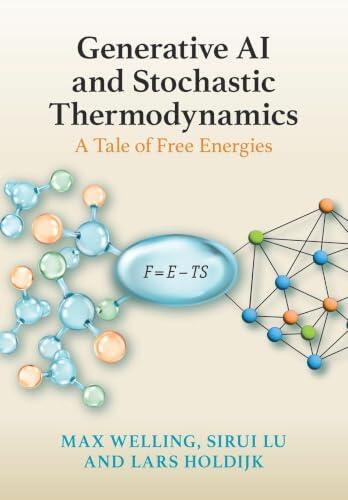
'Just as thermodynamics proved key to understanding the age of steam, stochastic thermodynamics will prove key to understanding the age of AI. This book is the first comprehensive guide to the principles of stochastic thermodynamics and how they relate to modern AI. It is much needed and will be widely read.' Neil Lawrence, University of Cambridge
'Generative AI now shapes science and industry, but its conceptual underpinnings are often opaque even to those who use it daily. This text develops an elegant unifying perspective grounded in the physics of stochastic thermodynamics ― an angle no other book has explored at this depth. An inspiring resource for researchers in both fields.' Miranda Cheng, Academia Sinica
'In Generative AI and Stochastic Thermodynamics, Max Welling achieves something rare and thrilling: a beautiful marriage of two deep and historically separate fields, weaving together the principles of modern AI with the elegant formalism of statistical physics. Complex ideas are presented with remarkable clarity and care, never sacrificing mathematical rigor for the sake of accessibility, yet remaining wonderfully approachable throughout. This book is an essential read for anyone working at the intersection of AI and the physical sciences, and I have no doubt it will inspire a new generation of cross-disciplinary thinking.' Rose Yu, UC San Diego
'Generative AI and statistical physics keep rediscovering each other's ideas under different names. This book presents both fields in the same framework and is the most interesting textbook I have read this year. It taught me new things about areas I thought I knew well. I strongly recommend it for anyone interested in AI and physics.' Jascha Sohl-Dickstein, Anthropic
'This book describes the surprising connection between probabilistic machine learning and non-equilibrium thermodynamics. In particular the concept of variational free energy acts as the connecting bridge between these fields. In generative AI, diffusion models further underscore this deep mathematical relationship. By exposing this surprising connection, the book will hopefully catalyse new developments in the rich field of AI+Science.' Geoffrey Hinton, Professor Emeritus, University of Toronto
Biografía del autor
Max Welling is Full Professor in Machine Learning at the University of Amsterdam. He is co-founder and CTO of the startup CuspAI. Professor Welling is a member of the Dutch Royal Academy of Sciences and was the recipient of the ECCV Koenderink Prize in 2010 and the ICML Test of Time award in 2021.
Sirui Lu is Doctoral Researcher at the Max Planck Institute of Quantum Optics, Germany. His research directions are the deep integration between (quantum) physics and artificial intelligence. Previously, he obtained his bachelor's degree from the Department of Physics at Tsinghua University, Beijing.
Lars Holdijk is Ph.D. student at the University of Oxford. His research focusses on the intersection of Generative Artificial Intelligence, Computational Biochemistry and Statistical Physics.

Añadir una reseña
Su e-mail no será publicado. Los campos obligatorios estan señalados
Su puntuación *
Necesita Acceder a su cuenta o Registrarse